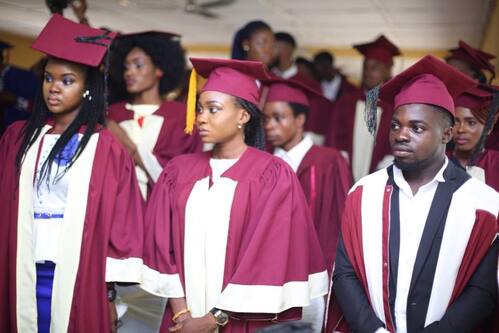
Colleges and Programs of Obong University
College of Social Sciences
Degrees in: Economics (B.Sc.), International Relations (B.Sc.), Peace Studies/Conflict Resolution (B.Sc.), Political Science (B.Sc.), Sociology (B.Sc.), and Social Work (B.Sc.)
College of Arts and Communications
Degrees in: English and Literary Studies,(B.Sc.) Christian and Religious Studies (B.Sc.), Mass Communication (B.Sc.)
Degrees in: Accounting (B.Sc.), Business Administration (B.Sc.), Public Administration (B.Sc.), Marketing (B.Sc.)
Degrees in: Computer Science (B.Sc.), Biochemistry (B.Sc.), Microbiology (B.Sc.)
College of Health Sciences
Degrees in: Nursing Science (BNSc), Medical Laboratory Science (BMLS)
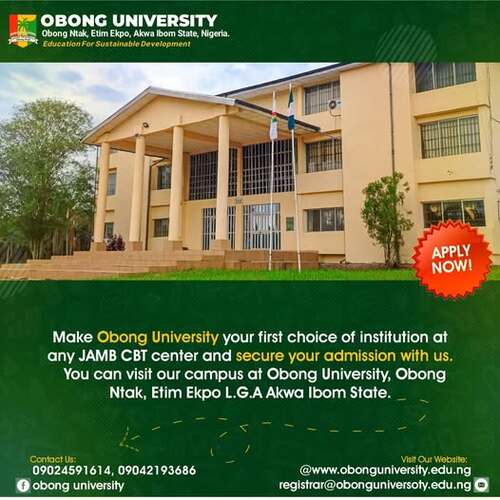
Faculty Who Teach with Purpose
At Obong University, academic excellence begins with educators who combine scholarly knowledge, professional experience, and a commitment to students’ intellectual, ethical, and personal development.
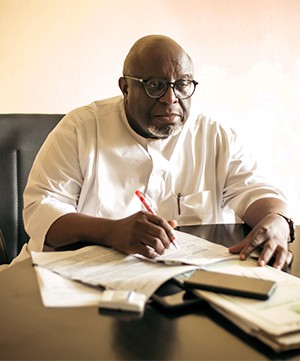
Professor Emmanuel Umana, Obong University Vice Chancellor
"Challenge yourself to change the world. Education becomes meaningful only when it can change the world when necessary — this is what my colleagues and I work for every single day."
Experienced Scholars and Practitioners
OU’s academic community includes professors, associate professors, PhD-qualified lecturers, and other experienced faculty members serving across the university’s five academic faculties. Their backgrounds in teaching, research, professional practice, public service, industry, and ministry help students connect academic knowledge with real-world responsibility.
Preparing Students for Responsible Influence
Instruction at OU challenges students to:
- Think critically and engage ideas thoughtfully
- Develop professional knowledge and practical competence
- Reason ethically and act with integrity
- Connect academic learning with Christian faith
- Understand leadership as service
Students are prepared not simply to earn a degree, but to use their education wisely, faithfully, and for the good of society.
Learning Beyond the Classroom
Academic preparation becomes more meaningful when students apply what they learn and engage with knowledge beyond a single classroom. OU supports this through practical experiences and relationships with academic, research, and professional institutions.
Turning Knowledge Into Practice
Students connect academic study with real-world application through:
- Laboratory instruction and applied coursework
- Fieldwork and practical assignments
- The Students Industrial Work Experience Scheme (SIWES), Nigeria's structured industrial-placement program
- Internships and other professional experiences
These opportunities help students develop practical competence, professional confidence, and a clearer understanding of how their education can be used in their chosen fields.
Academic Relationships that Expand Opportunity
OU also cultivates relationships with universities, research organizations, and other institutions in Nigeria and abroad. These connections can strengthen research, faculty collaboration, specialized training, and exposure to wider academic and professional communities.
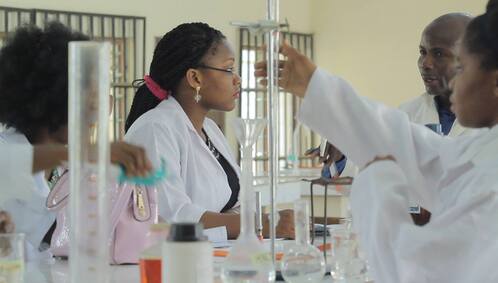
Excellent Laboratories and Facilities Enable OU Students
to Engage in Learning Beyond the Classroom
to Engage in Learning Beyond the Classroom
Infrastructure for Contemporary Learning
Effective higher education requires dependable access to electricity, information, and digital resources. OU continues to strengthen the infrastructure students and faculty need for teaching, research, communication, and academic work.
More Reliable Power
Campus solar systems provide a more dependable source of electricity for classrooms, laboratories, student housing, technology, and essential university operations.
Stronger Digital Connectivity
Starlink internet service expands access to online information and supports instruction, research, university administration, faculty collaboration, and student learning.
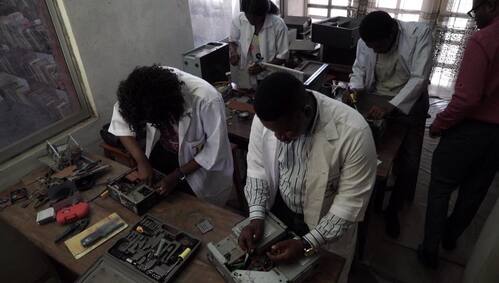
Obong University Students Working on Computer Hardware
Technology for Teaching and Research
Digital devices and ICT systems help students and faculty:
- Access academic information and research resources
- Integrate technology into teaching and coursework
- Communicate and collaborate more effectively
- Develop skills needed in contemporary professions
Together, these investments provide a stronger foundation for academic excellence while supporting the personal instruction, mentorship, and Christian formation central to an OU education.
More Than Credentials

Faith and Professional Formation
Graduates are equipped with:
- Professional knowledge and practical competence
- Discipline and a strong work ethic
- Christ-centered ethical judgment
- Integrity in decision-making
- A commitment to leadership through service
They are prepared to carry Christian character into their professions, institutions, communities, and the wider society.

Where an OU Education Leads
An Obong University education prepares graduates for continued learning, meaningful work, and lives of faithful influence.
After Graduation
OU graduates pursue opportunities such as:
- Postgraduate study
- Professional certification and specialized training
- Employment in their chosen fields
- Teaching and education
- Ministry and church leadership
- Entrepreneurship
- Government and public service